

This design was announced as winner of Zaph Design Contest. The design had gone through some changes but you can read the original submission.
Follow the build discussions at HTGuide Forum.
Concept:
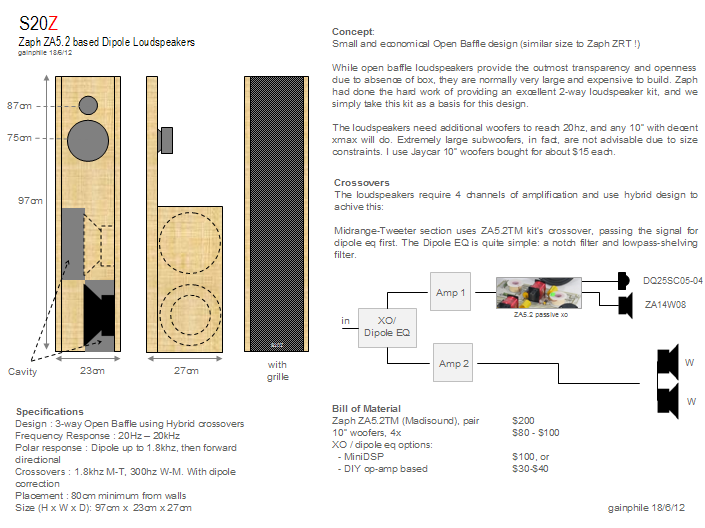
Compact and economical Open Baffle design, similar dimensions to a typical 5" hifi floorstander!
While open baffle loudspeakers provide the outmost transparency and openness due to absence of box, they are normally very large and expensive to build. Zaph had done the hard work of providing an excellent 2-way loudspeaker kit, and we simply take this kit as a basis for this design.
The loudspeakers need additional woofers to reach 20hz, and any 10” with decent xmax will do. Extremely large subwoofers, in fact, are not advisable due to size constraints. I use Jaycar 10” woofers bought for about $15 each.
Specifications
Design : 3-way Open Baffle using Hybrid crossovers
Frequency Response : 20Hz – 20kHz
Polar response : Dipole 20hz to 1.8khz, then forward directional
Crossovers : 1.8khz M-T, 220hz W-M (Asymmetric). With dipole correction
Placement : 80cm minimum from front walls, 50cm from sides
Size (H x W x D): 97cm x 23cm x 27cm
Tweeters: Vifa DQ25SC16-04
Midbass: Zaph|Audio ZA14W08
Woofers: 4x 10"
Crossovers
The loudspeakers require 4 channels of amplification and use hybrid design to achive this:

Midrange-Tweeter section uses ZA5.2TM kit’s crossover, passing the signal for dipole eq first. The Dipole EQ is quite simple: a notch filter and lowpass-shelving filter
Bill of Material
Zaph ZA5.2TM Kit (Madisound), pair $200
10” woofers, 4x $80 - $100
XO / dipole eq options:
- MiniDSP $100, or
- DIY op-amp based $30-$40

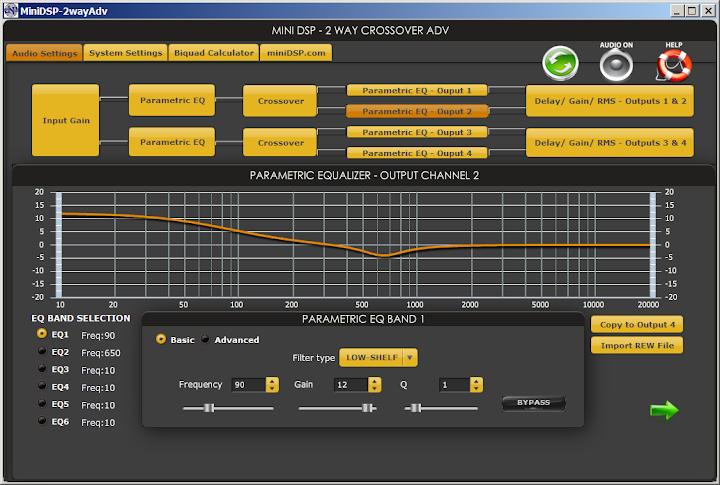
MiniDSP Crossover Settings
Woofer Section:

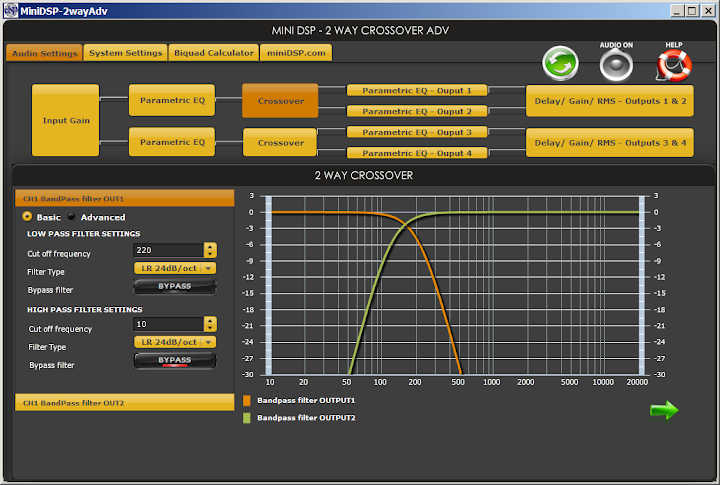
Image - 220Hz LR4 Crossover
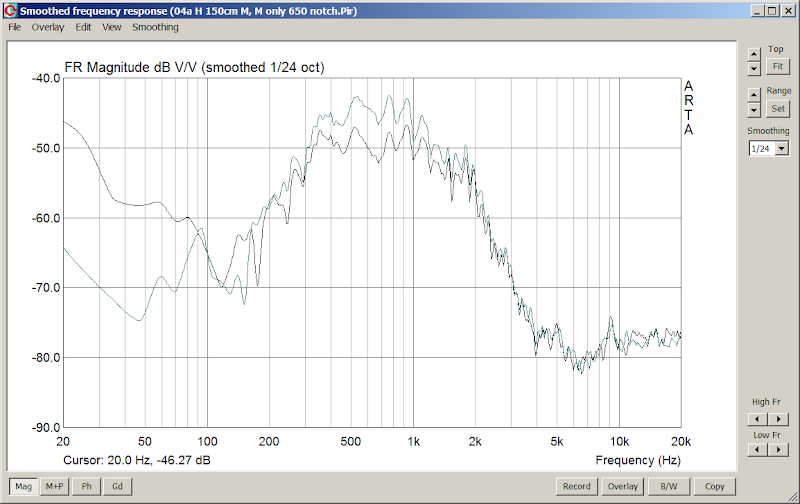
Image - 330Hz/-16dB/2.8Q quarterwave resonance notch filter (measured)
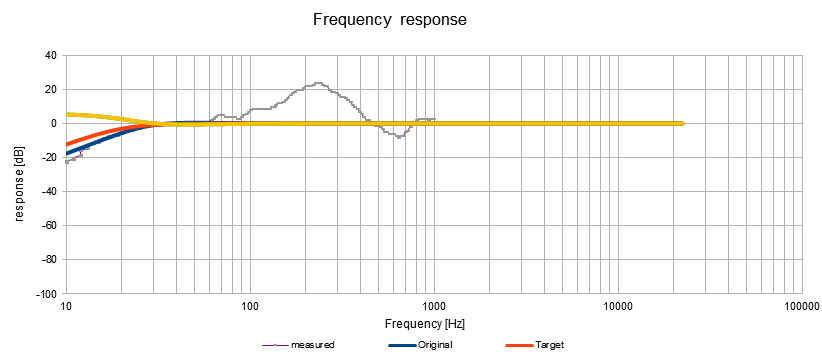
Image - 20Hz/0.7Q Linwitz Transform biquad correction (measured)
Image - 6db/oct Dipole rolloff EQ
The above Linkwitz Transform is for Jaycar CW2139. It will be different for other woofers, depending on the original Fs and Qts of the driver.
A very good value Woofer is Dayton Audio SD270A-88. Low Fs, good xmax, good price and reliably sourced from PartsExpress. If that is the chosen woofer, the Linkwitz Transform Biquad will be as follows:
Using Dayton SD270A-88 Sub
(Credit to SVEN from DIYAudio for providing the measurements):
Image - Linkwitz Transform for Dayton SD270A-88.
Image - Dayton SD270A-88 subwoofer FR modelling
Note: If you have other woofers in mind, please provide me with .frd nearfield measurement on the cabinet mouth and I will gladly publish the LT biquad parameters.
Midbass & Tweeter Section

Image - 120Hz LR4 Asymmetrical crossover
Image - 650Hz/-4.2dB/1.4Q Notch for dipole peak EQ (measured)
Image - 6db/oct Shelving-Lowpass dipole rolloff EQ
Image - Overall response of the panel. Note the dip at 3.8khz which needs to be investigated
Most critical of these settings is the 650Hz dipole notch. It is directly related to the front-rear separation and hence the baffle width. The final loudspeaker build had a baffle width of exactly 21.5cm. If your baffle is wider, the notch will be moved to lower frequency. The notch frequency can only be reliably measured outdoor/anaechoic conditions.
The crossover is 120hz asymmetrical to compensate floor reflections. This puts large demand on the 5" midbass. I play loud enough to fill in a 4.5m x 8m living room with no issues. But for extreme SPL, you may want to change it to 220Hz.
A null is observed at 3.8khz which deserve further investigation.
Other Settings

Image - 2π to 4π radiation space transition
Image - delay and attenuation
As with any other loudspeaker design, the top half of S20Z fires to full space (4π), while the bottom half fires to half-space (2π). This needs to be compensated accordingly using shelving highpass filter.
The combination of CW2139 and Zaph kit does not need further attenuation. With SD270A-88 above it might need minor tuning.
Updates
10/7/12 - Drivers shipped and on their way to down under !
17/7/12 - Drivers arrived.
29/7/12 - First dipole sub built and measured.
12/8/12 - Woodworking completed. The final design is actually smaller than planned.

10/7/12 - Drivers shipped and on their way to down under !
17/7/12 - Drivers arrived.
29/7/12 - First dipole sub built and measured.

15/8/12 - Preliminary crossover system and listening impressions observed.
14/9/12 - Outdoor measurements taken.
19/10/12 - Crossover configuration and measurements posted
9/7/13 - Other narrow dipole sub possibilities: Z Frame, Z Frame2, W-Frame, M-Frame
10/7/13 - wmcarpenter's adaption using Zaph MTM kit and 4x Bipole woofers
12/7/13 - danvprod's build progress using Markaudio fullrange driver







22 comments:
Great project!
I was excited to see that Zaph selected a slim-baffle OB design because I'm working on one myself. I'm happy that you are doing it because your documented designs are always thorough and educational.
http://www.diyaudio.com/forums/multi-way/211816-waveguie-cardioid-slim-baffle.html
I ran into some trouble with my design so I'm curious how you are implementing the lower end. In my case the crossover between the woofers and mid is proving challenging because of the location of the dipole peak and to larger extent because I can't get reliable indoor measurements in the lower midrange. Also since the woofers require a significant boost I'm encountering noise when playing at higher levels. I'm using a multi-channel amp and I wonder if amps with different gain for the top and the bottom part are a better approach.
Hi Boris, great project you got there. I actually did something similar the past 2 weeks to try creating enough delay to create cardioid polar pattern. The reason is I wanted smooth transition to single forward firing tweeter. It's too cold here at the moment, though to do outdoor measurements so I really can't confirm whether it was really cardioid. From past experience outdoor measurement and raising them to at least 1.5m is a must. For anything above 1khz the indoor measurements are ok.
Great!
WAF-friendly Open baffle which may also be quite inexpensive...
:)
Vix
Great!
WAF-friendly Open baffle which may also be quite inexpensive...
:)
Vix
Hey, how about some directivity plots? I'm contemplating building these in the near future. Also, I've had atleast one person raise their doubts about the 'any 10" woofer with decent xmax" bit.
Hey -- Great design! I am going to try and build these with the Parts Express drivers. I was thinking of maybe using a mark audio full-range driver instead of the Zaph. Do you think that would be reasonable?
Also how sensitive are the absolute dimensions of the woofer cabinet. I was thinking of using shelving materials for the main pieces to avoid rip cuts -- they are 12" wide. So was thinking of making the footprint 9x12" and then 23" tall. How big did you end up making the LF part of the design. I see you deviated a bit from the original design and made a two-piece speaker box. Many thanks in advance!
Hi Dan, as followed up at DIYAudio :)
Hi, I've been looking for a relatively affordable dipole project to do, and I am very intrigued by this one.
I was wondering if other 2-way bookshelf designs would be better suited to this design, such as Mark K's ER18 reed cone / DXT tweeter? It calls for a baffle that is around the same width. Your dipole design guide would seem to indicate that it would be easy enough to adapt.
Hi Nicolas, the ER18DXT would be great because the better directivity of the DXT tweeter and larger ER18 would provide more SPL. Settings should not be far off but it really needs to be measured. Have fun.
Hello Andi.
My name is Nishit. I am 24, Indian and into 60s pop, prog, indie, post-rock, and so on.
My reference point for a half decent playback system is Alessandro Music Series One.
Looking to put together my first speaker system. My room is 15.5 X 9 X 8. This is rented apt though and we will be moving next year. But just to give you an idea of the room sizes here. Presently I have enough space, if I were to put them, behind and to the sides.
I have allotted 700$ for the whole system. I might be able to stretch it to 800. Right now, the breakdown looks like this. 200$ for the mids and tweeters. 160 for the woofers. 170 for nanodigi. 150 for usb-spif converter and two dacs.
I have to make a choice between dropping the nanodigi option and settle with minidsp. That way I can buy 60w 41hz monoblocks + 100w autocostruires that someone has for sale. They are built with better parts. I tend to believe your objectivist view that most modern amplifiers if built well contribute less audible distortion than the speakers. Do you run the s20zs with your sure 8 channel?
So, in summary. Minidsp - d/a from pc- a/d + d/a on midisp. Or better built amps with slightly more power than the sures. Lastly, is it possible to use the same config files you've put up on the nanodigi?
Thanks.
I hope I am allowed to post back to back. Can you provide measurements for the cavities the woofers go in? Actually, a step by step guide, for the measurements of the cutouts would be perfect.
Mistakes on diagram - driver diameters...
Mistakes in diagram - on driver diameters...
No problems. Will provide cavity measurements.
Thanks so much Andi. Also, I pretty much cleared up my doubt about the amps and the dacs. Ministreamer + Minidigi + Minidsp. So, you don't need to answer the nanodigi question. I do however, have a few questions about the s20zs. If you have the time, I'd like to ask you. Where would be a good place to ask?
Hi,
Is the resonance at:
http://www.htguide.com/forum/showthread.php?40124-Ultra-compact-dipoles&p=557414&viewfull=1#post557414
Structure of the panel of the Z baffle flexing? a central brace would help if it was.
Hi Andi,
I built a pair of LX Mini clones about a year ago, and am hooked on the sound. However, although they sound terrific, I can't get the concert SPL levels I want to hear sometimes. So I am interested in building the S20Z speakers. The question I have: is the Dayton DC 250-8 10" woofer acceptable as a substitute for the Dayton SD270A 88? The SD270A 88 is out of stock and not expected to be available until mid March. I checked both PE, Ebay, and Amazon. It's also important that speakers sound good at low levels as well as high and I am assuming these do. Thanks in advance.
Lansing
Hi Andi,
I built a pair of LX Mini clones about a year ago, and am hooked on the sound. However, although they sound terrific, I can't get the concert SPL levels I want to hear sometimes. So I am interested in building the S20Z speakers. The question I have: is the Dayton DC 250-8 10" woofer acceptable as a substitute for the Dayton SD270A 88? The SD270A 88 is out of stock and not expected to be available until mid March. I checked both PE, Ebay, and Amazon. It's also important that speakers sound good at low levels as well as high and I am assuming these do. Thanks in advance.
Lansing
Hi Lansing, that woofer will do although with different Qts the setting needs to be modified accordingly (not difficult). But I'm worried that you want concert level with this speaker, as 5" mid-woofer simply won't do the SPL required.
HI Andi, thanks for getting back. Before I built the LX Mini takeoffs, I had KEF Q900s, which got louder than I needed, but the SQ was not there at lower listening levels. The current speakers have a Vifa TC9FD 18-08 full range and a 6" Dayton RS-150-4 woofer. Both setups were augmented with a commercial 15" sealed subwoofer. So I guess the question is will the S20-Z design give me more SPL than the minis? Should I consider going MTM?
You may wonder why I am interested in this design if I already have a sub. Or maybe not? What I really want is to do something like your S-12 design, totally active xover, as I feel the upper bass would lose definition with slot loading. The sub could handle 60hz on down and I could cross the woofs over to the mids higher.
A thought that came to mind was to build the S-12 bottom and use the S20-Z top end. Any input you might have about all this is much appreciated. Thanks again.
Gainphile I know this is an old post, but I was thinking about building a hybrid open baffle like the lxMini, but with more ooph. Would you still recommend this design? How does it sound? Thanks!
The LXMini will have more oomph due to the sealed woofers, and possibility to add more subs, I think. This design sounds pretty good but with single front-firing tweeters you will notice sooner or later. It really needs to be symmetrical (just like the evolution of the Orions)
Post a Comment